Services | Everything between a buying signal and a signed agreement
Pipeline reporting board tracking opportunities after the booking
Services

Everything between a buying signal and a signed agreement.

The build starts with the Diagnostic. Always.

One system, built in stages, with a gate at each one. Nothing goes live until your technical team has approved what it says.

01

You are not buying campaigns. You are buying a pipeline system.

Campaigns are the visible part. The part that decides your quarter is everything around them: who gets targeted and why, what the message argues to each stakeholder, what happens after a reply, and what the CRM does with an opportunity that stalls.

Signal Proof builds all of it, in order, with a gate between each stage. Nothing is turned on because it is ready to be turned on. It is turned on because the stage before it held.

Buying triggerRight accountRight stakeholderQualified conversationOpportunity progression
02

Five systems that have to work together.

Each one is written here as a problem and an outcome, because that is how it will be judged once it is running.

01

Signal intelligence

Problem

Your list tells you who fits, never who is buying.

Built

ICP definition, trigger mapping, account scoring and buyer-committee mapping.

Outcome

A prioritised market where every account has a documented reason for being there.

02

Authority foundation

Problem

Security buyers decide whether you belong in about one paragraph.

Built

Positioning, campaign landing pages, technical FAQs, trust sections and the Technical Evidence Document.

Outcome

Claims that survive technical scrutiny.

03

Account-based outreach

Problem

One message sent to four stakeholders convinces none of them.

Built

Trigger-led email, conservative LinkedIn engagement, persona-specific messaging for CISO, CIO, IT director, CFO and owner, plus retargeting for engaged accounts.

Outcome

Conversations that start at the account's actual deadline.

04

Opportunity conversion

Problem

Meetings get booked, then quietly disappear.

Built

Qualification, no-show prevention, demo follow-up, objection nurture, CRM workflows and stalled-deal recovery.

Outcome

Fewer opportunities lost after the first interaction.

05

Pipeline reporting

Problem

Activity reports say nothing about commercial reality.

Built

Accounts engaged, qualified meetings, meeting-to-opportunity rate, pipeline created and pipeline progressed.

Outcome

You can see which trigger and which segment is actually producing.

03

Diagnosed in two weeks. Live in thirty. Proven by ninety.

Four phases, each with a gate that has to hold before the next one opens.

StageWhat happensThe gate
Phase 0Diagnostic

Market scored, triggers mapped, bottleneck named, 90-day plan written.

No build starts until the constraint is identified.

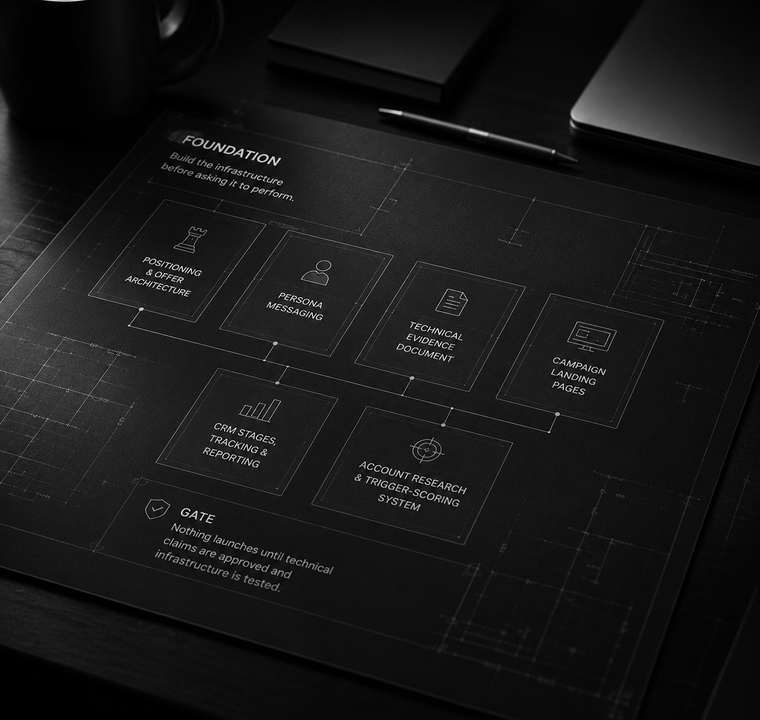
Phase 1Days 1 to 30

Positioning, persona messaging, Technical Evidence Document, campaign pages, CRM stages, account research.

Nothing launches until technical claims are approved and infrastructure is tested.

Phase 2Days 31 to 60

Controlled campaigns by segment, trigger family, persona and message angle.

No segment expands until meeting quality holds, not just reply volume.

Phase 3Days 61 to 90

Show rate, meeting-to-opportunity conversion, objection nurture, stalled-deal recovery, CRM progression.

Only the combinations creating genuine opportunities are expanded.

Book the Pipeline Diagnostic Phase 0 is where everything starts.
Account scoring table ranking fit and change signals
04

Your fastest security opportunity may already be a client.

Optional add-on for MSPs with an established client base. Net-new pipeline is only one half of the opportunity. We segment your current client base and identify accounts with unaddressed security needs or upcoming requirements.

Renewals and contract dates Compliance requirements Cyber-insurance controls
Book the Pipeline Diagnostic Find out whether the bigger opportunity is net-new, existing accounts, or both.
05

Three reasons this holds up in a market that punishes guesswork.

None of them are clever. All three are things a technical buyer can check.

01

It starts with a reason, not a list

Priority accounts are chosen on fit plus evidence that something has changed, so the first line of every message already has a justification.

02

It argues to the right person

The same audit reads as risk to the CISO, cost to the CFO, workload to the IT director and liability to the owner. Four arguments, one account.

03

It is accountable after the booking

Qualification, follow-up, CRM progression and stalled-deal recovery are part of the build, so a meeting has somewhere to go.

Before you build any of this, find out which part
is actually broken

  • Signal intelligence
  • Authority foundation
  • Account-based outreach
  • Opportunity conversion
  • Pipeline reporting

Most providers don't need all five systems on day one. They need to know which one is costing them the most opportunity right now.

Paid diagnostic. Credited in full against your build if you move forward.

Book the Pipeline Diagnostic