Extra Small Businesses and CMMC 2 Compliance
Written by Wes Lindquist. Last updated October 2026.
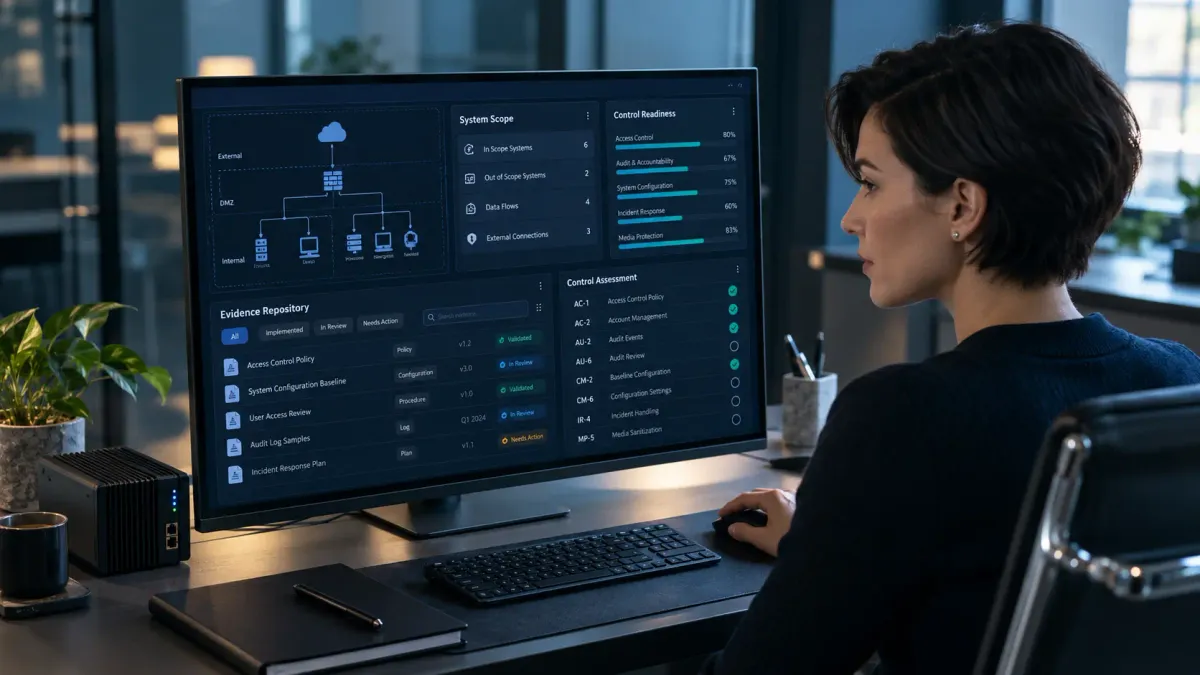
Extra small businesses and CMMC 2 compliance are closely linked when a company handles information tied to Department of Defense work. CMMC 2.0 is a cybersecurity assessment framework for defense contractors and subcontractors. The right preparation starts with contract review, data mapping, system boundaries, security controls, and evidence. Small size does not remove the need for clear security work.
Key points
- CMMC 2.0 compliance means a defense contractor has addressed the cybersecurity practices required for its contract and can support its claims with suitable
- Small businesses that support Department of Defense contracts should review CMMC requirements before bidding, renewing, or expanding work.
- CMMC affects a very small business by requiring clearer control over contract information, users, devices, suppliers, and evidence.
- A small business should begin with its contracts and information flows.
CMMC preparation also creates a business development issue for cybersecurity providers. Firms that sell managed security, consulting, assessment support, or remediation services need to find companies before a deadline becomes urgent. Signal Proof builds cybersecurity sales pipeline systems around buying triggers such as compliance deadlines, audits, insurance renewals, contract renewals, and leadership changes.
What is CMMC 2.0 compliance?
CMMC 2.0 compliance means a defense contractor has addressed the cybersecurity practices required for its contract and can support its claims with suitable evidence. The exact work depends on the information handled, the contract language, the system boundary, and the assessment path. Compliance is a defined security process, not a logo or a one-time software purchase.
A small contractor should treat CMMC as a question about information flow. Company leaders need to know what protected information enters the business, where staff store it, which systems process it, and who can access it. Security teams then compare that environment with the practices required for the applicable CMMC level.
The phrase “CMMC 2.0” describes the updated model used to organize those expectations. A contractor’s path may involve self-assessment or an assessment by an authorized party, based on the contract and required level. Contract documents should guide the decision. Marketing pages alone cannot establish the applicable path.
Which small businesses need to think about CMMC?
Small businesses that support Department of Defense contracts should review CMMC requirements before bidding, renewing, or expanding work. The need depends on contract terms and the type of federal information the company receives or creates. A company should review prime contracts, subcontracts, flow-down language, and customer instructions before choosing a compliance plan.
Extra small firms often lack a dedicated security team. One person may manage IT, cloud accounts, user access, vendors, and evidence. That arrangement does not make the work impossible, but it increases the risk of unclear ownership. A written plan gives each task an owner and a due date.
Start with these questions:
- Does the company support a defense contract or subcontract?
- Does the contract mention controlled information or cybersecurity requirements?
- Do employees use shared drives, email, cloud applications, or personal devices for contract work?
- Does a supplier, consultant, or managed service provider receive access?
- Does the company plan to bid on work with security clauses?
A business that cannot answer these questions should not guess. It should collect the relevant contract language and ask a qualified adviser to interpret the operational impact.
How does CMMC affect a very small business?
CMMC affects a very small business by requiring clearer control over contract information, users, devices, suppliers, and evidence. The business must understand its scope and show how it protects the information within that scope. Small teams may need outside support when internal staff lack time or security expertise.
The work usually touches daily operations. User accounts need review. Devices need an ownership record. Access rights need a reason. Backup and incident processes need written steps. Staff need guidance that matches the systems they actually use.
A small business can reduce confusion by separating contract work from general office activity where practical. A defined environment may make access review and evidence collection easier. The boundary must reflect real operations, not an attractive diagram that leaves active connections unexplained.
Leaders should avoid buying tools before defining the problem. A security product may produce logs, alerts, or reports, but those outputs do not prove that the company understands its scope or follows its written process. People, technology, and records must support the same plan.
What should a small business do first?
A small business should begin with its contracts and information flows. Gather the relevant clauses, identify the information involved, list the systems that touch it, and assign one person to coordinate the review. Early clarity prevents the company from paying for work outside its real boundary.
- Collect contract and subcontract language.
- Mark references to controlled information, security practices, assessments, or flow-down requirements.
- Interview staff who receive, create, store, or send contract information.
- Record devices, applications, cloud services, suppliers, and user groups.
- Draw a simple data-flow map.
- Create a gap list with an owner, target date, and proof required.
The first review should include business leaders, technical staff, and anyone who handles contract records. A single IT interview can miss informal workarounds, personal accounts, removable media, or supplier access.
The output should be a short scope statement. It should explain what information is covered, where it lives, who uses it, and which systems support that use. The statement can change as the business learns more, but it should exist before remediation begins.
What does a CMMC 2 compliance gap assessment include?
A CMMC 2 compliance gap assessment compares the company’s current security practices with the practices required for its contract path. The review examines scope, policies, technical safeguards, user activity, supplier access, and available evidence. A useful assessment records both the gap and the proof needed to close it.
A practical review covers:
- Scope: information types, systems, locations, users, devices, applications, and external services.
- Access: account creation, privilege changes, authentication, remote access, and account removal.
- Protection: device settings, network controls, storage, transmission, backups, and malware defenses.
- Detection: logging, alert handling, review duties, and incident records.
- Recovery: response steps, contact lists, restoration tasks, and lessons from tests.
- Governance: policies, training, risk decisions, supplier terms, and management approval.
The assessor or adviser should ask how each process works in practice. A policy that nobody follows is weak evidence. A tool that nobody reviews creates the same problem. Interviews, configuration checks, records, and demonstrations should tell a consistent story.
The final report should separate urgent risks from documentation gaps. It should state what the business must change, who owns the action, and what evidence will show completion. A long list without ownership gives leaders little control over the work.
How should a company define its CMMC boundary?
A company should define its CMMC boundary by tracing contract information from receipt to storage, use, sharing, and disposal. The boundary should include every system and service that supports those actions. Written diagrams, asset lists, account records, and supplier details should agree with the stated boundary.
Boundary work often exposes hidden connections. A user may forward records to a personal inbox. A supplier may support a cloud application. A shared laptop may serve both contract and ordinary office work. A backup service may hold copies that staff forgot to include.
Use a simple register with columns for:
| Area | Record to capture | Question to answer |
|---|---|---|
| Information | Data type and location | What contract information exists here? |
| People | Users and roles | Who needs access, and why? |
| Devices | Computers, servers, and mobile equipment | Which devices connect to the environment? |
| Applications | Cloud and local software | Where do users view or change records? |
| Suppliers | Providers and subcontractors | Who can access or support the system? |
| Evidence | Logs, reviews, policies, and tickets | What proves the process operates? |
A narrow boundary is not automatically a better boundary. An incomplete boundary can create a serious mismatch between the company’s claim and its actual environment. Scope decisions should follow real data movement and contract instructions.
What does CMMC 2 compliance certification mean?
CMMC 2 compliance certification means an organization has completed the assessment or review required for its contract path and can support the result with appropriate records. The word “certification” should not be used loosely. A vendor’s product, policy template, or readiness letter does not by itself prove a CMMC result.
Businesses should distinguish four things:
- Readiness work: finding and fixing gaps before review.
- Assessment preparation: organizing scope, practices, records, and staff responses.
- Formal assessment or self-assessment: following the path required by the contract.
- Ongoing maintenance: keeping controls, records, and scope accurate after the review.
A contractor should ask what authority supports a proposed assessment, what level applies, what evidence the reviewer expects, and how the result will be recorded. Contract language remains the starting point.
Cybersecurity providers should describe their role accurately. A managed service provider may configure systems, monitor alerts, collect records, and support remediation. Those services can support readiness, but the provider should not promise a formal result that it does not control.
What belongs on a CMMC 2.0 compliant list?
A CMMC 2.0 compliant list should contain the company’s in-scope assets, users, services, policies, practices, evidence, open risks, and review dates. The list should connect each required practice to a real owner and a record that shows operation. A generic checklist is useful only after the company defines its environment.
A working list might include:
- Approved systems and devices
- User and administrator accounts
- Access approvals and review records
- Security policies and procedures
- Staff training records
- Configuration standards
- Vulnerability and patch records
- Log sources and review notes
- Incident response contacts
- Backup and recovery test records
- Supplier access and contract terms
- Risk decisions and corrective actions
- Evidence location and retention owner
Each entry needs a status. Useful labels include “not started,” “in progress,” “operating,” “evidence collected,” and “ready for review.” Dates matter because a completed task without a record may be hard to defend later.
The list should stay current as systems change. A new cloud service, employee, supplier, or contract can change the boundary. Monthly or quarterly review intervals should match the company’s risk and contract needs rather than a copied calendar.
How can cybersecurity firms support CMMC buyers?
Cybersecurity firms can support CMMC buyers by connecting technical work to a clear business trigger. Buyers usually need help after a contract change, audit concern, insurance renewal, supplier request, or leadership decision. A provider should explain the first useful step instead of presenting a long product catalogue.
A sales conversation can follow this path:
- Confirm the contract context and business trigger.
- Learn what information the company handles and where it moves.
- Identify the systems, suppliers, and staff involved.
- Separate scope questions from control gaps.
- Agree on a diagnostic, assessment, or remediation next step.
- Record the opportunity and planned follow-up in the CRM.
Signal Proof’s work includes market diagnosis, account research, trigger-led outreach, qualification, CRM follow-up, and opportunity progression. The approach helps cybersecurity firms focus on accounts with a reason to act rather than sending broad messages to every small contractor.
Good outreach should use plain language. A message about “supporting your CMMC boundary review after a contract renewal” gives a buyer a clear reason to respond. A message full of unnamed controls and vague promises creates more work for the reader.
How should a small business prepare evidence?
A small business should prepare evidence while each process operates, not during the final week before review. Evidence can include approved policies, access records, configuration reports, training records, tickets, logs, meeting notes, and test results. Each record should show what happened, who performed it, and when it happened.
Evidence needs context. A screenshot without a date or system name may raise questions. A policy without an approval record may not show that leaders adopted it. A ticket marked “complete” may not explain what changed.
Create an evidence index with these fields:
| Field | Purpose |
|---|---|
| Practice or requirement | Links the record to the review area |
| Evidence name | Identifies the file or system record |
| Owner | Names the person responsible |
| Date range | Shows when the process operated |
| Location | Lets an authorized reviewer find it |
| Review status | Shows whether the evidence is current |
| Notes | Records limits, exceptions, or follow-up |
Store evidence in a controlled location. Limit editing rights. Keep old versions when they explain past decisions. Review the index after major system or contract changes.
Common mistakes in CMMC preparation
The most common preparation mistakes come from unclear scope, unsupported claims, and late evidence collection. A company may buy security tools while missing a supplier connection. Another may write policies that do not match daily work. A third may assume a general IT review covers contract information.
Watch for these warning signs:
- Staff cannot identify where contract information resides.
- The asset list excludes cloud services or remote devices.
- Former users still have active accounts.
- One shared administrator account has no clear owner.
- Suppliers receive access without written review.
- Policies have no approval date or assigned owner.
- Logs exist, but nobody records review activity.
- The business cannot explain its assessment path.
- Evidence lives in personal inboxes or local folders.
A gap list should rank issues by contract impact, exposure, effort, and dependency. Fixing the easiest item first may feel productive, but it can delay a decision about the system boundary. Scope and ownership usually deserve early attention.
How can leaders plan the work without losing control?
Leaders can plan CMMC work by turning the review into a managed program with clear decisions, owners, dates, and evidence. The program should show what the company knows, what remains uncertain, and what needs outside help. A short weekly review can keep blocked tasks visible.
A sensible plan has four stages:
- Discover: review contracts, information flows, assets, people, and suppliers.
- Decide: confirm scope, applicable path, priorities, owners, and budget.
- Remediate: fix security and process gaps, then collect supporting evidence.
- Maintain: review changes, test procedures, update records, and prepare for future checks.
Small companies should avoid treating the plan as a one-time project. New staff, devices, cloud services, customers, and suppliers can change the environment. The plan needs a change process that staff can follow without creating heavy paperwork.
Leaders should ask for plain reports. A useful report states the current scope, the largest unresolved risks, the work completed, the evidence collected, and the decision needed next. Technical detail belongs in supporting records, not in place of a clear business decision.
FAQ
Does a small company need CMMC?
A small company may need CMMC when its defense contract or subcontract includes applicable cybersecurity requirements. Company size alone does not answer the question. Leaders should review contract language, information handled, flow-down terms, and the required assessment path.
Is CMMC 2.0 a software product?
CMMC 2.0 is a cybersecurity assessment framework, not a software product. Software can support logging, access control, configuration, evidence collection, or monitoring. Tools do not replace scope decisions, written processes, staff action, or the required assessment route.
Can an MSP make a company CMMC compliant?
An MSP can support readiness by managing systems, improving controls, monitoring activity, and collecting records. The client remains responsible for its contracts, information, scope, decisions, and assessment obligations. The MSP should state exactly what its service covers.
How long does CMMC preparation take?
CMMC preparation time depends on the company’s scope, current security practices, contract needs, evidence quality, and available staff. A defined scope and a focused gap assessment give leaders a better estimate than a generic project timeline.
Does a checklist prove compliance?
A checklist does not prove compliance by itself. The company must show that required practices apply to its defined environment and operate in practice. Evidence should connect each item to an owner, system, date, process, and review record.
What should a contractor do before hiring a provider?
A contractor should gather contract language, identify the information involved, list systems and suppliers, and write down its main uncertainty. The provider can then discuss scope, readiness, remediation, assessment support, or managed services with clearer facts.
CMMC preparation becomes more manageable when a small business treats scope, ownership, evidence, and contract language as one connected workstream. Cybersecurity firms can support that work through focused diagnosis and trigger-led sales rather than broad, generic outreach.
Next step for cybersecurity providers
Signal Proof offers a paid Pipeline Diagnostic and credits the full fee if a client moves forward with the build. Use the diagnostic to review your market, buying triggers, account targets, outreach, qualification, CRM follow-up, and opportunity progression.
Book a paid Pipeline Diagnostic for your cybersecurity sales pipeline